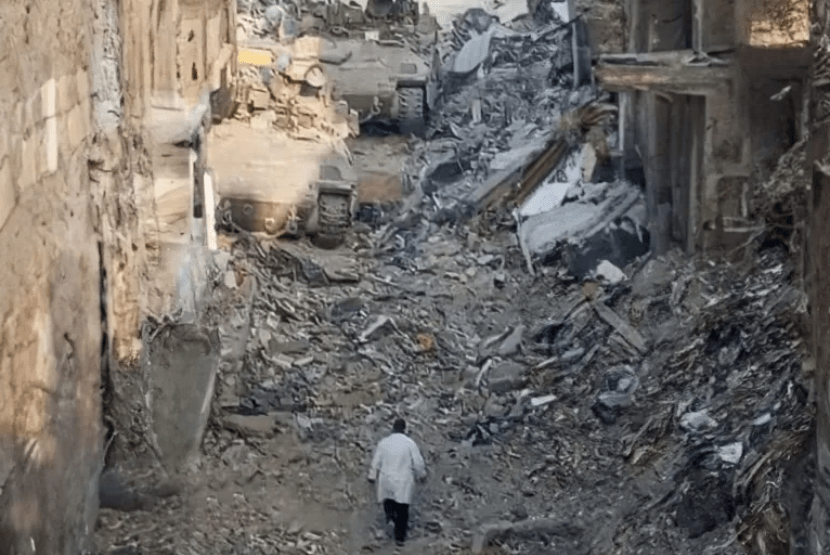
A man in a white coat, seen from behind, walks through the rubble towards a tank. This is the last image we have of Dr Hussam Abu Safiya. These images are now circling the globe, as thousands of people from every corner of the world call loudly for his immediate release.
The first reports, shared by two Palestinian hostages released a few weeks ago, seem to confirm that the doctor is still being held in Sde Taiman prison, a facility located in the Negev Desert. This prison has repeatedly come under international scrutiny through investigations by outlets such as CNN, MEE, and THE NEW YORK TIMES , which have identified it as a site of torture and severe abuse against detainees.
The independent, non-profit organisation Euro-Med Human Rights Monitor, which focuses on monitoring besieged territories, also reported that the doctor had already been tortured before his deportation to Sde Taiman prison.
A detainee who was held in the same facility testified that the doctor suffered a brutal beating, resulting in a bloodied and injured eye. This news is all the more alarming due to the doctor’s pre-existing health condition: in November, he had been seriously injured in his left leg by shrapnel during an Israeli drone attack.
Now the world bears witness to a man who, until his final moments of freedom, worked tirelessly, fighting against everything and everyone. For the past fifteen months of hell, this doctor never stopped, through his videos, appealing for his hospital to be spared from repeated military raids and urging all humanitarian organisations to provide the aid needed to ensure the survival of the facility and its patients.
Throughout these months, his determination to stay in his hospital and help as many people as possible never wavered, even on 26 October, when, after defying yet another order to evacuate, he faced the devastating loss of his beloved son, Ibrahim, aged 21, killed just steps from the hospital entrance.
Dr Safiya himself, only moments after his son’s death, declared that it was a clear act of retaliation for refusing to abandon his hospital. To this day, a harrowing video of the funeral can still be found online: the doctor recites the “Salat al-Janazah”, the Muslim funeral prayer, with the lifeless body of his son at his feet, wrapped in a white shroud. At the close of the ceremony, in an improvised cemetery behind the hospital, Dr Safiya goes on to bury his son.
A father who, after losing his son in such a tragic way, returns to his work, this stands among the greatest lessons in humanity that this man could offer us. Even more, his heroic act is a stark rebuke to the “lords of war” who, with all their violence, arrogance and brute force, believe they can extinguish in others the very capacity for human compassion: the empathy and selflessness toward our fellow beings. These are values that have no price on any market, they can neither be bought nor sold, but are earned daily, sometimes at the cost of suppressing even one’s own pain. This, above all, is what our heroic doctor has taught us throughout these months.
Miriam Millaci
 Controcorrente
Lascia un commento